
Abstract
Objective
Pain-related metacognitive beliefs are increasingly recognized as important contributors to maladaptive cognitive-emotional processes in chronic musculoskeletal pain. This study aimed to evaluate the psychometric properties and clinical utility of the Turkish version of the pain metacognitions questionnaire (PMQ-Turk).
Materials and Methods
A total of 210 participants (106 individuals with chronic musculoskeletal pain and 104 healthy controls) completed the PMQ-Turk together with validated measures of pain catastrophizing, emotional distress, mindfulness, pain severity, pain interference, and general metacognitive beliefs. Structural validity, reliability, convergent validity, measurement invariance, known-groups validity, and incremental validity were examined.
Results
The PMQ-Turk retained the original two-factor structure and demonstrated high internal consistency. Individuals with chronic musculoskeletal pain had significantly higher PMQ scores than healthy controls. Negative pain-related metacognitive beliefs were significantly associated with pain catastrophizing, emotional distress, pain interference, and dysfunctional metacognitive beliefs, and independently predicted pain catastrophizing after adjustment for demographic, clinical, emotional, and general metacognitive variables. ROC analyses suggested acceptable discrimination in identifying elevated pain catastrophizing.
Conclusion
The PMQ-Turk demonstrates good psychometric properties and appears to be a clinically relevant instrument for assessing pain-related metacognitive beliefs in Turkish-speaking individuals with chronic musculoskeletal pain. Incorporating pain-related metacognitive beliefs into clinical assessment may improve the identification of maladaptive cognitive-emotional processes and support individualized rehabilitation strategies.
Keywords: Pain metacognitions, chronic musculoskeletal pain, metacognitive beliefs, pain catastrophizing, psychometric properties, clinical assessment
Introduction
Chronic musculoskeletal pain is increasingly recognized as a multidimensional condition shaped not only by nociceptive mechanisms but also by cognitive, emotional, and behavioral processes. Beyond physical discomfort, chronic pain is associated with impaired daily functioning, reduced quality of life, emotional distress, and social limitations (,). Among the psychological mechanisms implicated in chronic pain, pain catastrophizing has consistently been associated with greater pain-related disability, greater emotional burden, and poorer clinical outcomes.
Pain catastrophizing refers to an exaggerated negative orientation toward actual or anticipated pain experiences and involves cognitive processes such as rumination, helplessness, and magnification. Although catastrophizing has traditionally been conceptualized within cognitive-behavioral frameworks, emerging evidence suggests that maladaptive beliefs about thinking itself may also contribute to the persistence of repetitive pain-related cognitions and to emotional distress. In this context, metacognitive theory offers an additional framework for understanding how maladaptive cognitive-emotional responses are maintained over time ().
Metacognition refers to the processes through which individuals monitor, interpret, and regulate their own thinking. In chronic pain, metacognitive beliefs may influence how pain-related thoughts are interpreted and managed, thereby contributing to persistent rumination, emotional distress, and maladaptive coping. According to Wells’ metacognitive model, emotional distress is influenced not only by the content of thoughts but also by beliefs regarding the meaning, usefulness, and controllability of thinking processes (). Dysfunctional metacognitive beliefs contribute to the activation and persistence of the cognitive attentional syndrome (CAS), characterized by repetitive negative thinking, persistent self-focused attention, threat monitoring, and maladaptive coping strategies such as suppression or avoidance. Positive metacognitive beliefs may encourage engagement in repetitive pain-related thinking (e.g., believing that focusing on pain is useful for coping), whereas negative metacognitive beliefs may increase perceptions that pain-related thoughts are uncontrollable and dangerous.
Beyond pain intensity itself, maladaptive cognitive-emotional processes are increasingly recognized as clinically relevant contributors to chronic pain-related disability and psychological distress. Emerging evidence suggests that metacognitive processes are associated with pain catastrophizing, emotional distress, health anxiety, and pain-related disability in chronic pain populations (-). Recent studies have further highlighted the potential role of maladaptive metacognitive functioning in fibromyalgia and related chronic pain conditions, suggesting that repetitive negative thinking and dysfunctional metacognitive beliefs may indirectly influence pain perception through emotional dysregulation and psychological distress (,).
Assessment of pain-specific metacognitive beliefs may therefore provide clinically relevant information beyond traditional cognitive measures by identifying beliefs that sustain maladaptive rumination, perceived uncontrollability of pain-related thoughts, and persistent emotional distress. Despite growing interest in metacognitive mechanisms in chronic pain, assessment tools specifically targeting pain-related metacognitive beliefs remain limited.
The pain metacognitions questionnaire (PMQ), developed by Schütze et al. (), was designed to assess positive and negative metacognitive beliefs related to pain-focused rumination and worry. The scale evaluates beliefs concerning both the perceived usefulness of pain-related thinking and the uncontrollability and harmful consequences associated with such cognitive processes. Validated instruments assessing pain-related metacognitive beliefs in Turkish-speaking chronic pain populations remain limited.
Cross-cultural adaptation of psychometric instruments is particularly important for assessing cognitive and metacognitive processes because these processes may be influenced by linguistic and cultural factors. Accordingly, the present study aimed not only to evaluate the psychometric properties of the Turkish version of the PMQ (PMQ-Turk), but also to examine the clinical relevance of pain-related metacognitive beliefs among individuals with chronic musculoskeletal pain, particularly with respect to pain catastrophizing, emotional distress, and maladaptive cognitive-emotional processing. We hypothesized that the PMQ-Turk would demonstrate a stable two-factor structure, satisfactory reliability, and meaningful associations with pain catastrophizing, emotional distress, and dysfunctional general metacognitive beliefs.
Materials and Methods
Translation and Cross-cultural Adaptation
Permission to translate and adapt the PMQ into Turkish was obtained from the original developer prior to the study. The translation process followed established cross-cultural adaptation procedures for self-report measures. First, the original English version was independently translated into Turkish by four bilingual researchers familiar with pain rehabilitation and psychological assessment. An expert panel reviewed the translated versions and produced a reconciled Turkish draft with emphasis on conceptual rather than literal equivalence. The reconciled version was then back-translated into English by an independent linguist blinded to the original questionnaire. The back-translated version was compared with the original PMQ to evaluate semantic consistency and conceptual compatibility. Following minor revisions based on expert consensus, the final PMQ-Turk () was established.
Study Design and Participants
This cross-sectional study was conducted in the outpatient clinic of the Department of Physical Medicine and Rehabilitation,Tokat Gaziosmanpaşa University Hospital, between January 2021 and June 2021. Ethical approval was obtained from the Tokat Gaziosmanpaşa University Clinical Researches Ethics Committee (approval no: 20-KAEK-316, date: 22.01.2021). All procedures were performed in accordance with the Declaration of Helsinki, and written informed consent was obtained from all participants prior to enrollment.
Participants in the chronic pain group were adults aged 18-65 years who had chronic mechanical musculoskeletal pain lasting at least three months. The sample included individuals with common non-inflammatory musculoskeletal pain conditions (chronic low back pain, neck pain, osteoarthritis-related pain, and myofascial musculoskeletal pain syndromes) encountered in routine outpatient rehabilitation practice.
Individuals were required to have sufficient literacy to complete self-report questionnaires independently. Participants with severe neurological or systemic diseases, active psychiatric disorders requiring ongoing treatment, malignancies, major sensory impairments, or significant musculoskeletal deformities interfering with assessment were excluded.
To ensure clinically meaningful symptom severity, individuals reporting mild pain [visual analog scale (VAS), score <3] were excluded. A healthy control group matched for age and sex was recruited from the community. Controls were screened for chronic pain conditions, severe medical illness, and current psychiatric treatment.
The final sample consisted of 106 individuals with chronic musculoskeletal pain and 104 healthy controls. The participant recruitment and assessment flow is illustrated in .
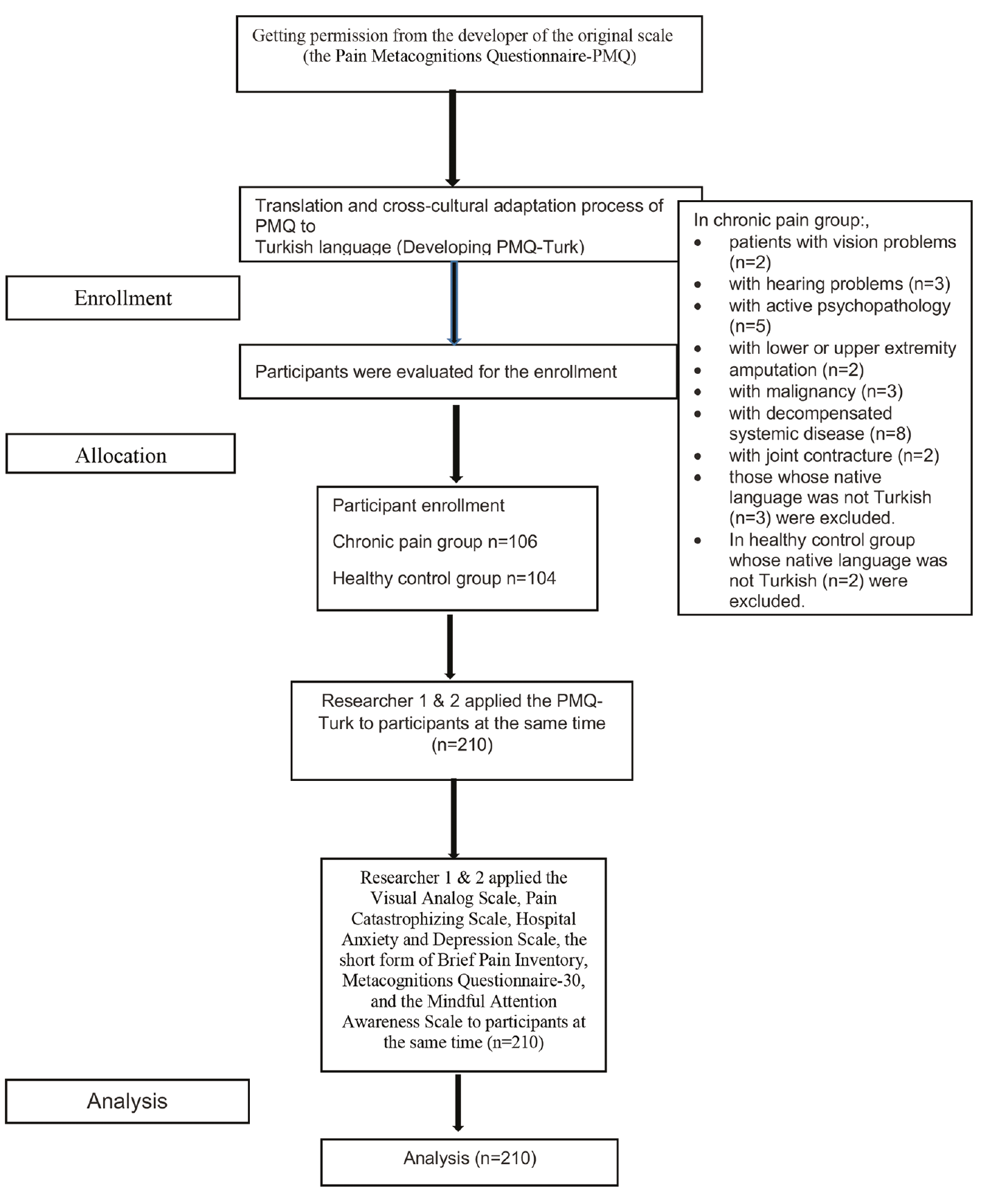
Flowchart of the study
Procedures and Measures
All assessments were conducted face-to-face by trained researchers using a standardized evaluation procedure. Participants completed the questionnaires individually in a quiet setting. Completed forms were reviewed for missing or unclear responses.
Pain Metacognitions Questionnaire
PMQ, developed by Schütze et al. (), is a 21-item self-report instrument designed to assess metacognitive beliefs associated with repetitive pain-focused thinking and rumination. The questionnaire comprises two subscales: positive pain-related metacognitions, reflecting beliefs about the perceived usefulness of thinking about pain, and negative pain-related metacognitions, reflecting beliefs about the uncontrollability and harmful consequences of pain-related thoughts.
In the Turkish version (PMQ-Turk), items are rated on a four-point Likert scale ranging from 0 (strongly disagree) to 3 (strongly agree). The positive metacognitions subscale consists of items 1-9, yielding a score range of 0-27, whereas the negative metacognitions subscale consists of items 10-21, yielding a score range of 0-36. Subscale scores are calculated by summing the corresponding item scores, with higher scores indicating stronger endorsement of the respective metacognitive beliefs. No reverse scoring is required. A total score ranging from 0 to 63 can also be calculated; however, the two subscale scores should be considered separately when interpreting specific metacognitive dimensions.
VAS
Pain intensity was assessed using the VAS, a widely used self-report measure ranging from 0 (“no pain”) to 10 (“worst imaginable pain”) ().
Brief Pain Inventory-short Form (BPI-SF)
Pain severity and pain-related interference were evaluated using the BPI-SF, which assesses the impact of pain on daily functioning across multiple domains (). The Turkish validity and reliability study of the BPI-SF was conducted by Celik et al. ().
Hospital Anxiety and Depression Scale (HADS)
Emotional distress was assessed using the HADS, a 14-item self-report measure consisting of anxiety and depression subscales (). Higher scores indicate greater emotional distress. The Turkish validity and reliability study of the HADS was performed by Aydemir ().
Pain Catastrophizing Scale (PCS)
Pain catastrophizing was evaluated using the PCS, which assesses maladaptive cognitive responses to pain, including rumination, magnification, and helplessness (). The Turkish validity and reliability study of the PCS was conducted by Ugurlu et al. ().
Mindful Attention Awareness Scale (MAAS)
Trait mindfulness was measured using the MAAS, a self-report instrument assessing present-moment attention and awareness in daily life (). The Turkish adaptation study of the MAAS was performed by Ozyesil et al. ().
Metacognitions Questionnaire-30 (MCQ-30)
General metacognitive beliefs were assessed using the MCQ-30, which evaluates dysfunctional metacognitive beliefs across several cognitive domains, including uncontrollability, cognitive confidence, and need for thought control (). The Turkish validity and reliability study of the MCQ-30 was conducted by Tosun and Irak ().
Statistical Analysis
Statistical analyses were performed using R software (version 4.5.0). Descriptive statistics were calculated for demographic and clinical variables. Group comparisons between chronic pain patients and healthy controls were conducted using independent-samples t-tests, with Welch’s correction when appropriate, and chi-square tests for categorical variables. Because PMQ items were ordinal, factor analyses were conducted using methods appropriate for ordered-categorical data. Preliminary analyses included examination of item distributions, corrected item-total correlations, the Kaiser-Meyer-Olkin measure, and Bartlett’s test of sphericity. Exploratory factor analysis (EFA) was performed using minimum residual extraction with oblimin rotation, and the number of factors was determined through parallel analysis. Confirmatory factor analysis (CFA) was subsequently conducted using the weighted least-squares, mean- and variance-adjusted estimator. Given the available sample size, EFA and CFA were conducted using the same sample; therefore, the CFA findings should not be considered an independent cross-validation of the factor structure. Model fit was evaluated using the comparative fit index (CFI), the Tucker-Lewis index (TLI), the root mean square error of approximation (RMSEA), and the standardized root mean square residual (SRMR). Measurement invariance across chronic pain and control groups was evaluated using multi-group CFA, and invariance was assessed using changes in CFI (ΔCFI≤0.01).
Internal consistency was evaluated using ordinal Cronbach’s alpha coefficients. Composite reliability and average variance extracted (AVE) were calculated from standardized CFA loadings. Convergent validity was examined through correlations between PMQ-Turk scores and measures of pain catastrophizing, emotional distress, pain severity, pain interference, mindfulness, and general metacognitive beliefs. Discriminant validity was additionally evaluated using the Fornell-Larcker criterion (based on AVE) and the heterotrait-monotrait ratio (HTMT).
Receiver operating characteristic (ROC) analyses were conducted as exploratory analyses to examine the discriminative performance of PMQ-Turk total and subscale scores for two criterion outcomes: chronic pain status (0= healthy control, 1= chronic musculoskeletal pain) and elevated pain catastrophizing, defined according to the criterion used in the original PMQ development study (PCS score ≥24). This PCS criterion was prespecified and was not derived using the Youden index. Chronic pain status was examined using known-groups discriminant analysis rather than as a diagnostic test. Area under the curve (AUC) with 95% confidence intervals (CIs) were calculated for the PMQ-Turk total score and for the positive metacognitions and negative metacognitions scores. The Youden Index was used solely to identify optimal PMQ-Turk thresholds for each outcome criterion.
Hierarchical linear regression analysis was conducted in the full sample (n=210) to examine whether pain-specific metacognitive beliefs explained incremental variance in pain catastrophizing beyond demographic, pain-related, emotional, and general metacognitive variables. Predictors were entered in five theoretically ordered blocks: demographic variables (age, sex, marital status, years of education, and employment status) at Step 1; BPI-SF pain severity and pain interference at Step 2; HADS depression and anxiety scores at Step 3; the five MCQ-30 subscales at Step 4; and PMQ-Turk positive and negative metacognitions scores at Step 5. Incremental validity was assessed using changes in explained variance (ΔR2) and the corresponding F-change statistics. R2 and ΔR2 values are reported to three decimal places.
All statistical tests were two-tailed and p-values were considered statistically significant.
Results
Sample Characteristics
The study included 210 participants, consisting of 106 individuals with chronic musculoskeletal pain and 104 healthy controls. The mean age of the sample was 37.5 years; age and sex distributions were comparable between groups. As expected, participants with chronic pain reported significantly higher scores for pain intensity, pain interference, emotional distress, and pain catastrophizing compared with healthy controls. Detailed demographic and clinical characteristics are presented in .
Table 1. Demographic and clinical characteristics of chronic pain and healthy control groups
Variable | Control (n=104) | Pain (n=106) | Test statistic (p) | Effect size |
|---|---|---|---|---|
Age (years) | 36.71 (9.80) | 38.34 (12.69) | t(197.16)=-1.04 (0.299) | d=0.14 |
Female (%) | 55.8% | 54.7% | χ2(1)=0.02 (0.89) | V=0.01 |
Marital status, married (%) | 45.7% | 61.9% | χ2(1)=5.54 (0.019) | V=0.16 |
Education (years) | 12.47 (3.45) | 11.00 (4.19) | t(198.72)=2.74 (0.007) | d=0.39 |
Employment status, regular income job (%) | 45.7% | 38.1% | χ2(1)=1.28 (0.258) | V=0.08 |
Pain severity (BPI) | 1.02 (1.45) | 5.12 (2.04) | t(175.34)=-18.47 (<0.001) | d=2.35 |
Pain interference (BPI) | 0.84 (1.21) | 4.87 (2.38) | t(162.21)=-16.93 (<0.001) | d=2.14 |
Pain intensity (VAS) | 0.75 (1.24) | 5.93 (2.17) | t(167.74)=-21.25 (<0.001) | d=2.76 |
Pain catastrophizing (PCS) | 12.71 (10.72) | 21.05 (11.89) | t(206.54)=-5.34 (<0.001) | d=0.74 |
Continuous variables are presented as mean (standard deviation). Group comparisons were conducted using Welch’s independent-samples t-tests for continuous variables and chi-square tests for categorical variables. Effect sizes are reported as Cohen’s d for continuous variables and Cramer’s V for categorical variables. BPI: Brief pain inventory, VAS: Visual analog scale, PCS: Pain catastrophizing scale
Reliability and Factor Structure
Item-level descriptive statistics demonstrated acceptable distributional properties and satisfactory item discrimination. Detailed item characteristics are presented in .
Table 2. Item-level descriptive statistics for PMQ-Turk (n=210)
Item | Mean | SD | Skewness | Kurtosis |
|---|---|---|---|---|
PMQ1 | 1.29 | 1.02 | 0.09 | -1.22 |
PMQ2 | 1.84 | 0.95 | -0.59 | -0.51 |
PMQ3 | 0.98 | 0.98 | 0.5 | -0.99 |
PMQ4 | 1.06 | 1.01 | 0.45 | -1.02 |
PMQ5 | 1.18 | 1.01 | 0.32 | -1.07 |
PMQ6 | 0.96 | 1.01 | 0.67 | -0.76 |
PMQ7 | 0.87 | 0.88 | 0.66 | -0.51 |
PMQ8 | 1.07 | 0.98 | 0.54 | -0.74 |
PMQ9 | 1.27 | 0.97 | 0.06 | -1.13 |
PMQ10 | 1.2 | 0.9 | 0.2 | -0.84 |
PMQ11 | 1.02 | 0.91 | 0.46 | -0.73 |
PMQ12 | 1.5 | 0.97 | -0.14 | -1.0 |
PMQ13 | 1.6 | 1.05 | -0.25 | -1.14 |
PMQ14 | 1.76 | 0.98 | -0.47 | -0.77 |
PMQ15 | 1.53 | 1.06 | -0.09 | -1.22 |
PMQ16 | 1.28 | 0.98 | 0.21 | -1.01 |
PMQ17 | 1.7 | 1.01 | -0.37 | -0.94 |
PMQ18 | 1.88 | 0.93 | -0.61 | -0.44 |
PMQ19 | 1.63 | 0.94 | -0.25 | -0.83 |
PMQ20 | 1.3 | 1.0 | 0.14 | -1.09 |
PMQ21 | 1.28 | 0.96 | 0.07 | -1.07 |
PMQ1-PMQ21 denote individual items of the pain metacognitions questionnaire (PMQ). Skewness and kurtosis values indicated acceptable item-level distributional properties. SD: Standard deviation
Preliminary analyses supported the suitability of the data for factor analysis. The Kaiser-Meyer-Olkin measure indicated excellent sampling adequacy, and Bartlett’s test of sphericity was statistically significant.
EFA supported a two-factor structure consistent with the original questionnaire, representing positive and negative pain-related metacognitive beliefs. Most items demonstrated satisfactory factor loadings on their expected dimensions (). Although two items demonstrated moderate cross-loadings, the overall factor solution remained theoretically coherent and closely aligned with the original PMQ structure.
Table 3. Exploratory factor analysis (Pattern Matrix)
Item | Negative (MR1) | Positive (MR2) |
|---|---|---|
PMQ1 | 0.268 | 0.434 |
PMQ2 | 0.192 | 0.478 |
PMQ3 | -0.077 | 0.813 |
PMQ4 | 0.003 | 0.707 |
PMQ5 | 0.128 | 0.611 |
PMQ6 | -0.107 | 0.732 |
PMQ7 | 0.005 | 0.734 |
PMQ8 | 0.152 | 0.536 |
PMQ9 | 0.117 | 0.671 |
PMQ10 | 0.405 | 0.305 |
PMQ11 | 0.210 | 0.441 |
PMQ12 | 0.753 | -0.100 |
PMQ13 | 0.743 | 0.038 |
PMQ14 | 0.761 | -0.043 |
PMQ15 | 0.781 | 0.008 |
PMQ16 | 0.505 | 0.067 |
PMQ17 | 0.744 | -0.092 |
PMQ18 | 0.603 | 0.083 |
PMQ19 | 0.822 | -0.006 |
PMQ20 | 0.766 | 0.017 |
PMQ21 | 0.601 | 0.129 |
MR1: Negative pain-related metacognitions, MR2: Positive pain-related metacognitions. Values represent pattern matrix loadings obtained using oblimin rotation. Primary factor loadings are shown in bold
CFA provided support for the proposed two-factor model: CFI and TLI were favorable (0.978 and 0.976, respectively), although RMSEA (0.101) and SRMR (0.091) were somewhat elevated. Standardized factor loadings are presented in . The two latent factors demonstrated a moderate positive correlation, indicating related but distinguishable constructs.
Table 4. Confirmatory factor analysis-standardized loadings
Item | Negative (Std.all) | Positive (Std.all) |
|---|---|---|
PMQ1 | - | 0.726 |
PMQ2 | - | 0.703 |
PMQ3 | - | 0.778 |
PMQ4 | - | 0.751 |
PMQ5 | - | 0.740 |
PMQ6 | - | 0.659 |
PMQ7 | - | 0.747 |
PMQ8 | - | 0.714 |
PMQ9 | - | 0.788 |
PMQ10 | 0.682 | - |
PMQ11 | 0.608 | - |
PMQ12 | 0.708 | - |
PMQ13 | 0.813 | - |
PMQ14 | 0.770 | - |
PMQ15 | 0.827 | - |
PMQ16 | 0.599 | - |
PMQ17 | 0.724 | - |
PMQ18 | 0.733 | - |
PMQ19 | 0.849 | - |
PMQ20 | 0.846 | - |
PMQ21 | 0.768 | - |
Model Fit: χ2(188)=588.36; CFI=0.978; TLI=0.976; RMSEA=0.101; SRMR=0.091. Std.all: Standardized factor loadings, CFI: Comparative fit index, TLI: Tucker-Lewis index, RMSEA: Root mean square error of approximation, SRMR: Standardized root mean square residual. Model estimation was performed using the WLSMV estimator for ordinal data
Internal consistency coefficients were high for both subscales (ordinal αs >0.80), supporting the reliability of the PMQ-Turk.
Measurement Invariance
Measurement invariance analyses indicated that the two-factor structure of the PMQ-Turk operated similarly across chronic pain and healthy control groups. Configural, metric, and scalar invariance models demonstrated acceptable model fit (CFI=0.987-0.989, TLI=0.986-0.988, RMSEA=0.067-0.073), and changes in fit indices remained within recommended thresholds (ΔCFI <0.01), supporting full measurement invariance. These findings suggest that the factor structure, factor loadings, and item thresholds were equivalent across groups, supporting valid comparisons of latent factor means between groups.
Convergent and Discriminant Validity
Convergent validity was examined through correlations between PMQ-Turk scores and theoretically related constructs, including pain catastrophizing, metacognitive beliefs, emotional distress, pain severity, and pain interference. Both PMQ-Turk subscales demonstrated significant positive associations with pain catastrophizing, dysfunctional metacognitive beliefs, emotional distress, and pain-related outcomes. Notably, negative pain-related metacognitive beliefs demonstrated the strongest associations with maladaptive cognitive-emotional variables, particularly those regarding uncontrollability, danger, and the need for thought control (r=0.538-0.564, p<0.001). PMQ scores were also positively associated with pain severity and pain interference, supporting criterion-related validity. In addition, both subscales demonstrated small-to-moderate positive correlations with anxiety and depressive symptoms. Consistent with theoretical expectations, PMQ-Turk scores were inversely associated with mindfulness.
Discriminant validity was supported by both the Fornell-Larcker criterion and HTMT analyses. The square root of the AVE values for both factors exceeded the inter-factor correlation, and the HTMT ratio (0.70) remained below recommended thresholds, indicating that positive and negative pain-related metacognitive beliefs represented related but distinguishable constructs. Overall, these findings provide strong evidence for the convergent and discriminant validity of the PMQ-Turk.
Known-groups and ROC Findings
Participants with chronic musculoskeletal pain reported significantly higher positive and negative pain-related metacognitive beliefs than healthy controls; effect sizes were larger for negative metacognitive beliefs and for total PMQ scores. These findings support the known-groups validity of the PMQ-Turk and its ability to discriminate between clinical and non-clinical populations.
To further explore the potential clinical utility of the PMQ-Turk, exploratory ROC analyses were conducted. For chronic musculoskeletal pain status, the PMQ-Turk total score yielded an AUC of .715 [95% CI (0.646, 0.783)], with a Youden-optimized threshold of 29.5 (≥30), sensitivity of 0.698, and specificity of 0.654. Negative metacognitions yielded an AUC of 0.717 [95% CI (0.648, 0.785)], with an optimal threshold of 16.5 (≥17), sensitivity of 0.764, and specificity of 0.577. Positive metacognitions yielded an AUC of 0.672 (95% [CI (0.600, 0.743)], with an optimal threshold of 11.5 (≥12), sensitivity of .566, and specificity of 0.673.
Discrimination was stronger for higher levels of pain catastrophizing. The PMQ-Turk total score yielded an AUC of 0.859 [95% CI [0.803, 0.915)], with a Youden-optimized threshold of 32.5 (≥33), sensitivity of 0.828, and specificity of 0.750. Negative metacognitions yielded an AUC of 0.857 [(95% CI (0.802, 0.912)], with an optimal threshold of 20.5 (≥21), sensitivity of 0.845, and specificity of 0.763. Positive metacognitions yielded an AUC of 0.751 [95% CI (0.677, 0.825)], with an optimal threshold of 11.5 (≥12), sensitivity of 0.724, and specificity of 0.658. These PMQ-Turk thresholds should be considered exploratory, sample-derived cut-points requiring independent validation before clinical use.
Logistic regression analyses further indicated that PMQ-total significantly predicted chronic pain status. When both subscales were entered simultaneously, only negative metacognitions remained a significant independent predictor, whereas positive metacognitions showed no independent contribution. Detailed regression findings are presented in .
Table 5. Logistic regression predicting chronic pain status
Model 1. PMQ total | ||||||
Predictor | B | SE | z | p | OR | 95% CI for OR |
PMQ-total | 0.072 | 0.014 | 5.24 | <0.001 | 1.075 | (1.047, 1.106) |
Model fit: Nagelkerke R2≈0.21; Classification accuracy ≈68% SE: Standard error, OR: Odds ratio, CI: Confidencel interval
Incremental Validity
Hierarchical linear regression was conducted in the full sample (n=210) to examine the incremental contribution of pain-specific metacognitive beliefs to pain catastrophizing. Demographic variables entered at Step 1 explained 12.0% of the variance in pain catastrophizing (R2=0.120). Adding pain severity and pain interference at Step 2 increased the explained variance by 16.7% (ΔR2=0.167, p<0.001). Emotional distress variables at Step 3 accounted for a further 7.5% of the variance (ΔR2=0.075, p<0.001), while the addition of the five MCQ-30 subscales at Step 4 increased the explained variance by 11.3% (ΔR2=0.113, p<0.001). Finally, adding the PMQ-Turk positive and negative metacognitions subscales at Step 5 explained an additional 5.5% of the variance (ΔR2=0.055, p<0.001). The final model explained 53.1% of the variance in pain catastrophizing [R2=0.531, adjusted R2=0.492, F(,193)=13.65, p<0.001]. In the final model, age (β=0.126, p=0.041), HADS anxiety (β=0.161, p=0.024), MCQ-30 negative beliefs about uncontrollability and danger (β=0.196, p=0.017), MCQ-30 need to control thoughts (β=0.190, p=0.024), and PMQ-Turk negative metacognitions (β=0.254, p=0.001) were significant independent predictors. PMQ-Turk positive metacognitions did not independently predict pain catastrophizing (β=0.113, p=0.108). Detailed regression coefficients are presented in , .
Table 6. Hierarchical linear regression predicting pain catastrophizing in the full sample (n=210)
Predictor | B | SE | β | 95% CI for B | t | p |
|---|---|---|---|---|---|---|
Step 1: demographic variables | - | - | - | - | - | - |
Age | 0.134 | 0.065 | 0.126 | [0.005, 0.263] | 2.05 | 0.041 |
Sex | -1.087 | 1.274 | -0.045 | [-3.600, 1.426] | -0.85 | 0.395 |
Marital status | 1.879 | 1.543 | 0.078 | [-1.165, 4.923] | 1.22 | 0.225 |
Education (years) | -0.082 | 0.225 | -0.026 | [-0.525, 0.361] | -0.36 | 0.716 |
Regular-income employment | 2.166 | 1.528 | 0.089 | [-0.847, 5.180] | 1.42 | 0.158 |
Step 2: pain variables | - | - | - | - | - | - |
BPI-SF pain severity | 0.121 | 0.100 | 0.092 | [-0.076, 0.319] | 1.21 | 0.228 |
BPI-SF pain interference | 0.091 | 0.055 | 0.123 | [-0.017, 0.200] | 1.67 | 0.097 |
Step 3: emotional distress | - | - | - | - | - | - |
HADS depression | -0.014 | 0.218 | -0.004 | [-0.445, 0.416] | -0.06 | 0.949 |
HADS anxiety | 0.484 | 0.213 | 0.161 | [0.065, 0.904] | 2.28 | 0.024 |
Step 4: general metacognitions | - | - | - | - | - | - |
MCQ-30 lack of cognitive confidence | -0.201 | 0.254 | -0.058 | [-0.701, 0.300] | -0.79 | 0.430 |
MCQ-30 positive beliefs about worry | -0.464 | 0.251 | -0.132 | [-0.959, 0.030] | -1.85 | 0.066 |
MCQ-30 cognitive self-consciousness | -0.196 | 0.279 | -0.054 | [-0.747, 0.355] | -0.70 | 0.483 |
MCQ-30 negative beliefs about uncontrollability and danger | 0.666 | 0.275 | 0.196 | [0.123, 1.209] | 2.42 | 0.017 |
MCQ-30 need to control thoughts | 0.652 | 0.286 | 0.190 | [0.087, 1.217] | 2.28 | 0.024 |
Step 5: pain-specific metacognitions | - | - | - | - | - | - |
PMQ-Turk positive metacognitions | 0.220 | 0.136 | 0.113 | [-0.049, 0.488] | 1.61 | 0.108 |
PMQ-Turk negative metacognitions | 0.368 | 0.112 | 0.254 | [0.147, 0.588] | 3.28 | 0.001 |
B: Unstandardized regression coefficient, SE: Standard error, β: Standardized regression coefficient, CI: Confidence interval, BPI-SF: Brief pain inventory-short form, HADS: Hospital anxiety and depression scale, MCQ-30: Metacognitions questionnaire-30; PMQ-Turk: Turkish pain metacognitions questionnaire. Sex was coded as 0= female and 1= male, marital status as 0= single/divorced/widowed and 1= married; employment status as 0= no regular-income employment and 1= regular-income employment. Final model: R2=0.531, adjusted R2=0.492, F(16,193)=13. 65, p<0.001
Table 7. Model 2-PMQ subscales
Predictor | B | SE | z | P | OR | 95% CI for OR |
PMQ-positive | 0.048 | 0.032 | 1.52 | 0.130 | 1.049 | (0.986, 1.118) |
PMQ-negative | 0.088 | 0.025 | 3.59 | <0.001 | 1.092 | (1.042, 1.149) |
Model fit: Nagelkerke R2 ≈ 0.24; Overall model χ2 significant (p<0.001).
OR: Odds ratio, CI: Confidence interval. Chronic pain status was coded as 1= chronic pain and 0= healthy control. Nagelkerke R2 values are reported as indices of model fit
Table 8. Model progression
Step | R2 | ΔR2 | ΔF | p |
|---|---|---|---|---|
1. Demographics | 0.120 | 0.120 | — | <0 .001 |
2. + Pain variables | 0.287 | 0.167 | 23.58 | <0.001 |
3. + Emotional distress | 0.362 | 0.075 | 11.81 | <0.001 |
4. + General metacognitions | 0.476 | 0.113 | 8.44 | <0.001 |
5. + PMQ-Turk subscales | 0.531 | 0.055 | 11.36 | <0.001 |
Discussion
The present study evaluated the psychometric properties and clinical relevance of the PMQ-Turk in individuals with chronic musculoskeletal pain. Overall, the findings supported the reliability, construct validity, and clinical relevance of the PMQ-Turk and replicated the original two-factor structure representing positive and negative pain-related metacognitive beliefs. Importantly, negative pain-related metacognitive beliefs demonstrated stronger associations with pain catastrophizing, emotional distress, and chronic pain status, supporting their potential relevance to maladaptive cognitive-emotional processing in chronic pain.
Individuals with chronic musculoskeletal pain reported higher levels of pain catastrophizing, anxiety, and depressive symptoms compared with healthy controls, consistent with previous chronic pain literature (,). Beyond nociceptive mechanisms, chronic pain is increasingly recognized as a condition influenced by maladaptive cognitive-emotional processes (). In this context, repetitive negative thinking and dysfunctional pain-related beliefs may contribute to the persistence of psychological distress and pain-related disability. The observed associations between pain-related metacognitive beliefs, catastrophizing, and emotional distress are also consistent with metacognitive theory, which emphasizes the role of CAS processes in maintaining distress ().
The PMQ-Turk retained the original two-factor structure described in the initial validation study (). Although several items demonstrated moderate cross-loadings, the overall factor structure remained theoretically coherent and closely aligned with the original questionnaire. CFA findings, together with the standardized factor loadings, provided further support for the proposed two-factor structure, although the model fit indices were not uniformly optimal. Internal consistency coefficients were high for both subscales and comparable to those reported in the original PMQ validation study, supporting the reliability and cross-cultural applicability of the Turkish version. In addition, full configural, metric, and scalar invariance across chronic pain and healthy control groups was established, indicating that the PMQ-Turk measures pain-related metacognitive constructs equivalently across groups and supports valid comparisons of latent factor means ().
Both PMQ-Turk subscales demonstrated significant associations with pain catastrophizing, emotional distress, pain severity, pain interference, and dysfunctional general metacognitive beliefs. Notably, negative pain-related metacognitive beliefs demonstrated the strongest associations with maladaptive cognitive-emotional variables, particularly beliefs related to uncontrollability, danger, and need for thought control. This finding is consistent with metacognitive theory, which emphasizes beliefs regarding uncontrollability and threat as central mechanisms maintaining psychological distress (). Similar relationships between maladaptive metacognitive beliefs, catastrophizing, and emotional distress have previously been reported in chronic pain populations (,). Recent findings in fibromyalgia populations have likewise highlighted the potential role of maladaptive metacognitive beliefs and emotional dysregulation in chronic pain-related distress (). Discriminant validity findings further suggested that positive and negative pain-related metacognitive beliefs, although related, represent distinguishable constructs consistent with theoretical models of metacognitive functioning ().
The exploratory ROC findings suggest that PMQ-Turk scores particularly the negative metacognitions subscale may help identify individuals with elevated pain catastrophizing. Discrimination of chronic pain status was modest and should not be interpreted diagnostically, as the PMQ was developed to assess pain-related metacognitive beliefs rather than the presence or absence of chronic pain. In contrast, discriminative ability for elevated pain catastrophizing was stronger, with AUCs of approximately .86 for the total score and the negative Metacognitions score. Nevertheless, the corresponding Youden-derived PMQ-Turk thresholds were obtained from the present sample and require independent replication before they can be considered for clinical screening. This cautious interpretation is particularly important because test-retest reliability and longitudinal responsiveness were not examined in the present study. Accordingly, the two subscale scores may be used to characterize distinct dimensions of pain-related metacognitive beliefs, rather than to classify patients into predefined severity categories.
Importantly, negative pain-related metacognitive beliefs remained a significant independent predictor of pain catastrophizing even after controlling for demographic variables, pain severity, emotional distress, and general metacognitive beliefs. The incremental contribution of PMQ scores suggests that pain-specific metacognitive beliefs may provide clinically relevant information beyond broader metacognitive tendencies. This finding further supports the possibility that metacognitive processes associated with chronic pain may be at least partly domain-specific rather than solely reflecting generalized dysfunctional metacognitive styles.
The present findings may also have implications for rehabilitation-oriented interventions. Cognitive-emotional processes such as catastrophizing, repetitive negative thinking, and dysfunctional metacognitive beliefs are increasingly recognized as clinically relevant treatment targets in chronic pain management. Assessment of pain-related metacognitive beliefs may therefore provide additional insight into maladaptive coping styles and cognitive vulnerability. These findings may support future investigation of metacognitively informed rehabilitation approaches in chronic pain populations (,).
Study Limitations
Several limitations should be acknowledged. First, the cross-sectional design limits causal inference from the observed relationships. Second, all measures were based on self-report instruments and may therefore have been influenced by response bias. Third, test-retest reliability and longitudinal responsiveness were not evaluated, which limits conclusions regarding the temporal stability of the PMQ-Turk and its longitudinal clinical utility. EFA and CFA were conducted in the same sample because the available sample size was limited; therefore, the CFA did not provide independent cross-validation of the factor structure. Although the findings supported the proposed factor structure, replication in larger and more diverse clinical samples would strengthen the generalizability.
Conclusion
T he PMQ-Turk demonstrates good psychometric properties and appears to be a clinically relevant instrument for assessing pain-related metacognitive beliefs in Turkish-speaking individuals with chronic musculoskeletal pain. Negative pain-related metacognitive beliefs appear particularly relevant to pain catastrophizing and emotional distress. Assessment of pain-related metacognitive beliefs may contribute to a better understanding of maladaptive cognitive-emotional processes associated with chronic pain, and help inform rehabilitation-oriented assessment and intervention strategies.
Ethics
Ethics Committee Approval: The study was approved by the Tokat Gaziosmanpaşa University Clinical Research Ethics Committee (approval no: 20-KAEK-316, date: 22.01.2021). All procedures were conducted in accordance with the Declaration of Helsinki.
Informed Consent: Written informed consent was obtained from all participants prior to participation.
Footnotes
Authorship Contributions
Concept: N.Y., Z.Ç., S.B., Design: N.Y., Z.Ç., Data Collection or Processing: N.Y., Analysis or Interpretation: N.Y., Z.Ç., S.B., Literature Search: N.Y., Z.Ç., Writing: N.Y., Z.Ç., S.B.
Conflict of Interest
No conflict of interest was declared by the authors.
Financial Disclosure
The authors declared that this study received no financial support.
References
Gatchel RJ, Peng YB, Peters ML, Fuchs PN, Turk DC. The biopsychosocial approach to chronic pain: scientific advances and future directions. Psychol Bull. 2007;133:581-624.
Dansie EJ, Turk DC. Assessment of patients with chronic pain. Br J Anaesth. 2013;111:19-25.
Wells A. Metacognitive therapy for anxiety and depression. New York: Guilford Press; 2009.
Keen E, Kangas M, Gilchrist PT. A systematic review evaluating metacognitive beliefs in health anxiety and somatic distress. Br J Health Psychol. 2022;27:1398-422.
Schütze R, Rees C, Preece M, Schütze M. Low mindfulness predicts pain catastrophizing in a fear-avoidance model of chronic pain. Pain. 2010;148:120-7.
Hamonniere T, Varescon I. Metacognitive beliefs in addictive behaviours: a systematic review. Addict Behav. 2018;85:51-63.
Topaloğlu MS, Puşuroğlu M. the Effect of metacognitive and emotional Schemas on the severity of symptoms in patients with Fibromyalgia. Diagnostics (Basel). 2026;16:696.
Tenti M, Raffaeli W, Fontemaggi A, Gremigni P. The relationship between metacognition, anger, and pain intensity among fibromyalgia patients: a serial mediation model. Psychol Health Med. 2024;29:791-808.
Schütze R, Rees C, Smith A, Slater H, Catley M, O’Sullivan P. Assessing beliefs underlying rumination about pain: development and validation of the pain metacognitions questionnaire. Front Psychol. 2019;10:910.
Price DD, McGrath PA, Rafii A, Buckingham B. The validation of visual analogue scales as ratio scale measures for chronic and experimental pain. Pain. 1983;17:45-56.
Keller S, Bann CM, Dodd SL, Schein J, Mendoza TR, Cleeland CS. Validity of the brief pain inventory for use in documenting the outcomes of patients with noncancer pain. Clin J Pain. 2004;20:309-18.
Celik EC, Yalcinkaya EY, Atamaz F, Karatas M, Ones K, Sezer T, et al. Validity and reliability of a Turkish Brief Pain Inventory Short Form when used to evaluate musculoskeletal pain. J Back Musculoskelet Rehabil. 2017;30:229-33.
Zigmond AS, Snaith RP. The hospital anxiety and depression scale. Acta Psychiatr Scand. 1983;67:361-70.
Aydemir O. Validity and reliability of Turkish version of hospital anxiety and depression scale. Turk Psikiyatri Derg. 1997;8:280-7.
Sullivan MJL, Bishop SR, Pivik J. The pain catastrophizing scale: development and validation. Psychol Assess. 1995;7:524-32.
Ugurlu M, Karakas Ugurlu G, Erten S, Caykoylu A. Validity of Turkish form of pain catastrophizing scale and modeling of the relationship between pain-related disability with pain intensity, cognitive, and emotional factors. Psychiatry Clin Psychopharmacol. 2017;27:189-96.
Brown KW, Ryan RM. The benefits of being present: mindfulness and its role in psychological well-being. J Pers Soc Psychol. 2003;84:822-48.
Ozyesil Z, Arslan C, Kesici S, Deniz ME. Adaptation of the mindful attention awareness scale into Turkish. Educ Sci. 2011;36:224-35.
Wells A, Cartwright Hatton S. A short form of the metacognitions questionnaire: properties of the MCQ-30. Behav Res Ther. 2004;42:385-96.
Tosun A, Irak M. Üstbiliş ölçeği-30’un Türkçe uyarlaması, geçerliği, güvenirliği, kaygı ve obsesif-kompülsif belirtilerle ilişkisi. Turk Psikiyatri Derg. 2008;19:67-80.
Bair MJ, Robinson RL, Katon W, Kroenke K. Depression and pain comorbidity: a literature review. Arch Intern Med. 2003;163:2433-45.
Nicholson B, Verma S. Comorbidities in chronic neuropathic pain. Pain Med. 2004;5:S9-27.
Woo AK. Depression and anxiety in pain. Rev Pain. 2010;4:8-12.
Putnick DL, Bornstein MH. Measurement invariance conventions and reporting: the state of the art and future directions for psychological research. Dev Rev. 2016;41:71-90.
Kneeland ET, Griffin ML, Taghian N, Weiss RD, McHugh RK. Associations between pain catastrophizing and clinical characteristics in adults with substance use disorders and co-occurring chronic pain. Am J Drug Alcohol Abuse. 2019;45:488-94.
Romeo A, Di Tella M, Benfante A, Colonna F, Castelli L. Metacognition and pain in patients with fibromyalgia: the role of psychological distress. J Affect Disord. 2025;382:85-8.
Normann N, Morina N. The efficacy of metacognitive therapy: a systematic review and meta-analysis. Front Psychol. 2018;9:2211.
Wells A. Advances in metacognitive therapy. Int J Cogn Ther. 2013;6:186-201.
Supplementary Materials
Supplementary 1
Download